Social Engineering has a Grammar: You Have to Learn to Read It
Social engineering attacks follow a grammar. Jordan Schoenherr explains how sequence, script substitution, and conversational structure can reveal them.
Why Good Security Concepts Don't Always Work in Practice: The Problem with Enterprise and Shadow IT
The DEF CON 34 badge chip is a security marvel, but many organizations aren't equipped to make it useful. Here's the framework that explains why.
Why Signal's New Safety Features Are Fighting the Last Campaign
Signal’s response to a recent impersonation campaign shows why trusted channels need more than behavioral nudges to stop social engineering.
Outsourcing Attacks: The Division of Labor Inside Social Engineering Campaigns
Cybercriminals no longer act alone. Learn how modern social engineering attacks rely on specialized roles, dark supply chains, and outsourced labor.
The Cognitive Defense Network: What Studying an Organization's Nervous System tells us about Defense
Social engineering bypasses the security stack entirely by exploiting the social and cognitive layers beneath.
When Help Desks Harm: IT Procedural Impersonation Attacks
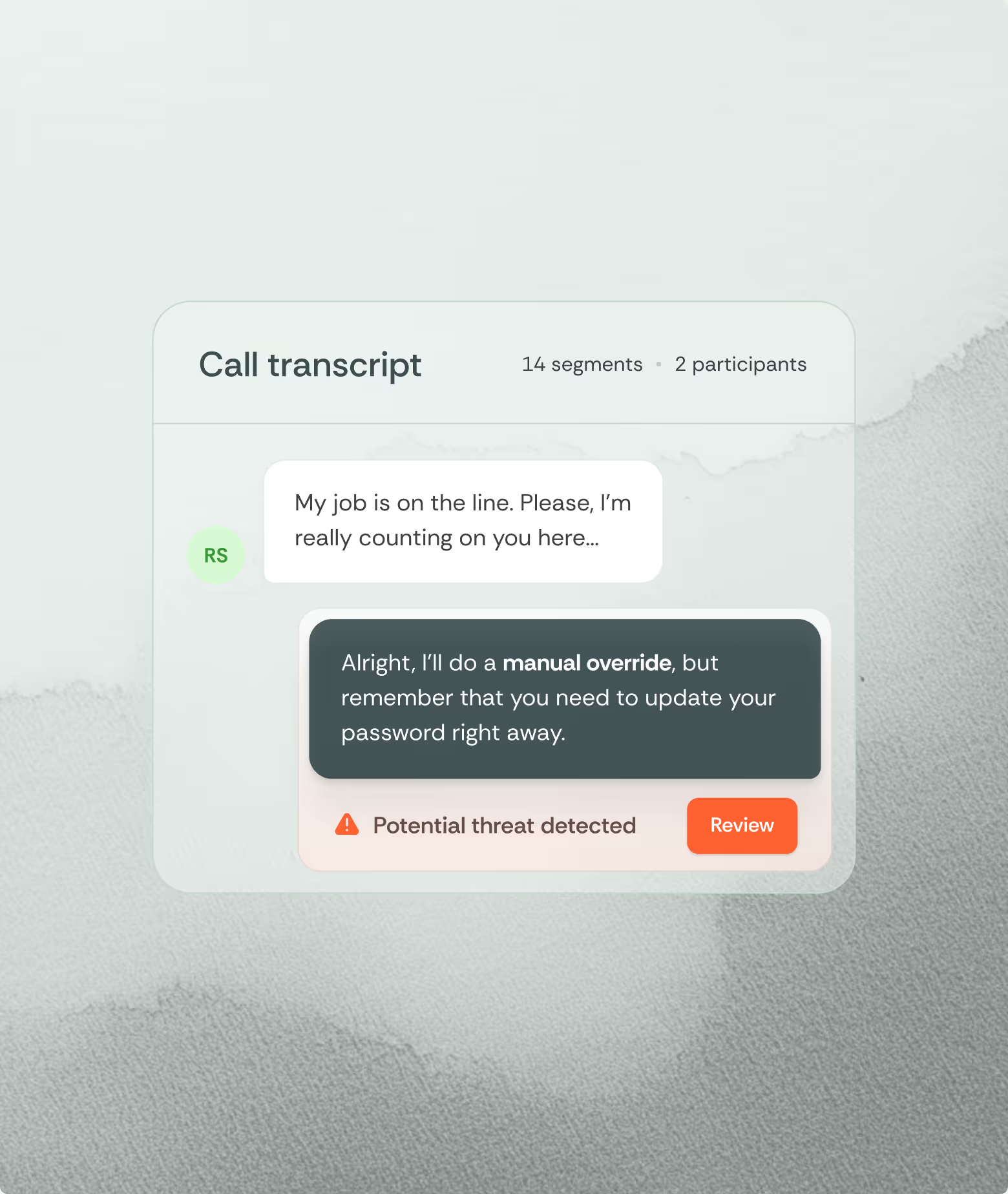
Attackers are now using Microsoft Teams to impersonate IT help desk staff by initiating chats, building trust, and walking employees through the steps necessary to grant remote access. It represents an overdue realization that the help desk is a valuable target.
Making Social Engineering Visible: Four Structural Problems in Organizations
Why do social engineering attacks keep bypassing mature security infrastructure? This article breaks down the Four T Problem and offers concrete steps to make human-layer threats visible before they succeed.
AiTM at Scale: What the Code of Conduct Campaign Reveals About Detection Architecture
A credential-theft campaign reached 35,000 users and cleared every automated control in the enterprise stack. Here's how adversary-in-the-middle attacks exploit the psychology of compliance — and what it takes to stop them.
Most recent
Jordan Schoenherr examines how World Cup ticket scams exploit real urgency and familiar digital experiences — and what they reveal about securing the human attack surface.
Attackers no longer need to deceive when they already have the data. Humanix Scientist Jordan Schoenherr examines why identity verification alone can't hold, and what comes next.
Severity labels, response thresholds, and automation bias shape what SOC teams investigate, including social engineering attacks hiding in routine signals.
CISA’s BOD 26-04 improves vulnerability prioritization, but better remediation depends on the people, processes, and capacity required to execute it.
AI agents are expanding the natural language attack surface. Learn how compliance attacks exploit prompts, memory, tools, and voice, and how security teams can respond.
Microsoft's SMS phase-out is the right move — but the transition itself opens a new attack surface. Here's what organizations need to do before the window closes.
This piece examines the psychological mechanics behind long-con pretexting attacks and why traditional defenses fail once trust has already been operationalized.
AI is industrializing social engineering. Learn how attackers are building their stack—and what defenders must do before the window closes.
The most sophisticated cyberattack of the year succeeded using the oldest trick in the book amplified with AI.
Security awareness programs are failing — employees don't care, but organizations often don't give them the tools or agency to act.
Social engineering demands psychology-based solutions, not just security policies and employee training.
Humanix has been selected as an RSA Innovation Sandbox finalist — one of the most competitive and respected recognitions in cybersecurity, awarded to a Top 10 group.
Social engineering is the top breach vector, and blaming victims doesn’t work. Humanix fights back by using AI to detect manipulation as it happens and protect people from human-targeted attacks.
Enter your contact info and we'll be in touch soon










.png)