The Dividend Attack: Why Healthcare's Workplace Culture Is the Ideal Target

The healthcare sector absorbed enough social engineering breaches over the last three months to draw a sector-wide threat notice. In July, Clover Health lost three employee accounts. In August, two McKesson employees were vished, extracting nearly a terabyte of data. By September, the Health-ISAC warned that ShinyHunters had targeted more than a dozen healthcare organizations with vishing calls and medical-themed lookalike domains. The consequences are significant. Case in point: the Change Healthcare breach affected an estimated 190 million individuals.
Healthcare offers attackers more than valuable records and financial returns. Its focus is helping people, not security. Attackers can exploit the very structures developed to provide care.
Why Collaborative Networks are Vulnerable
Healthcare organizations are collaborative networks built on trust, distributed decisions, and continuous exchange among clinicians, administrators, and external partners. Information routinely crosses professional and organizational boundaries. The same properties that enable care create opportunities for social engineering.
One key property that expands the attack surface is the prevalence of third-party personnel across these collaborative networks. Attackers can tailor their lures to healthcare workflows, including billing, HR, IT access, and clinical operations. An attacker impersonating an IT support contractor, for example, can replicate practices consistent with someone who should have privileged access. One report suggests that healthcare accounts for 41.2% of all third-party breaches in 2024.
Another property is the tendency for healthcare organizations to have a slower-moving, change-averse culture. Legacy systems, high-value data, and uninterrupted care are often cited. However, these explanations ignore the cognitive defenses that define organizational culture and influence how employees respond. Healthcare's vulnerabilities are defined by its security ecology: a system of interdependent behaviors, attitudes, cognitive strategies, and relational properties that produces a human attack surface unlike any other sector.
Prosocial Networks: Healthcare’s Ecological Weakness
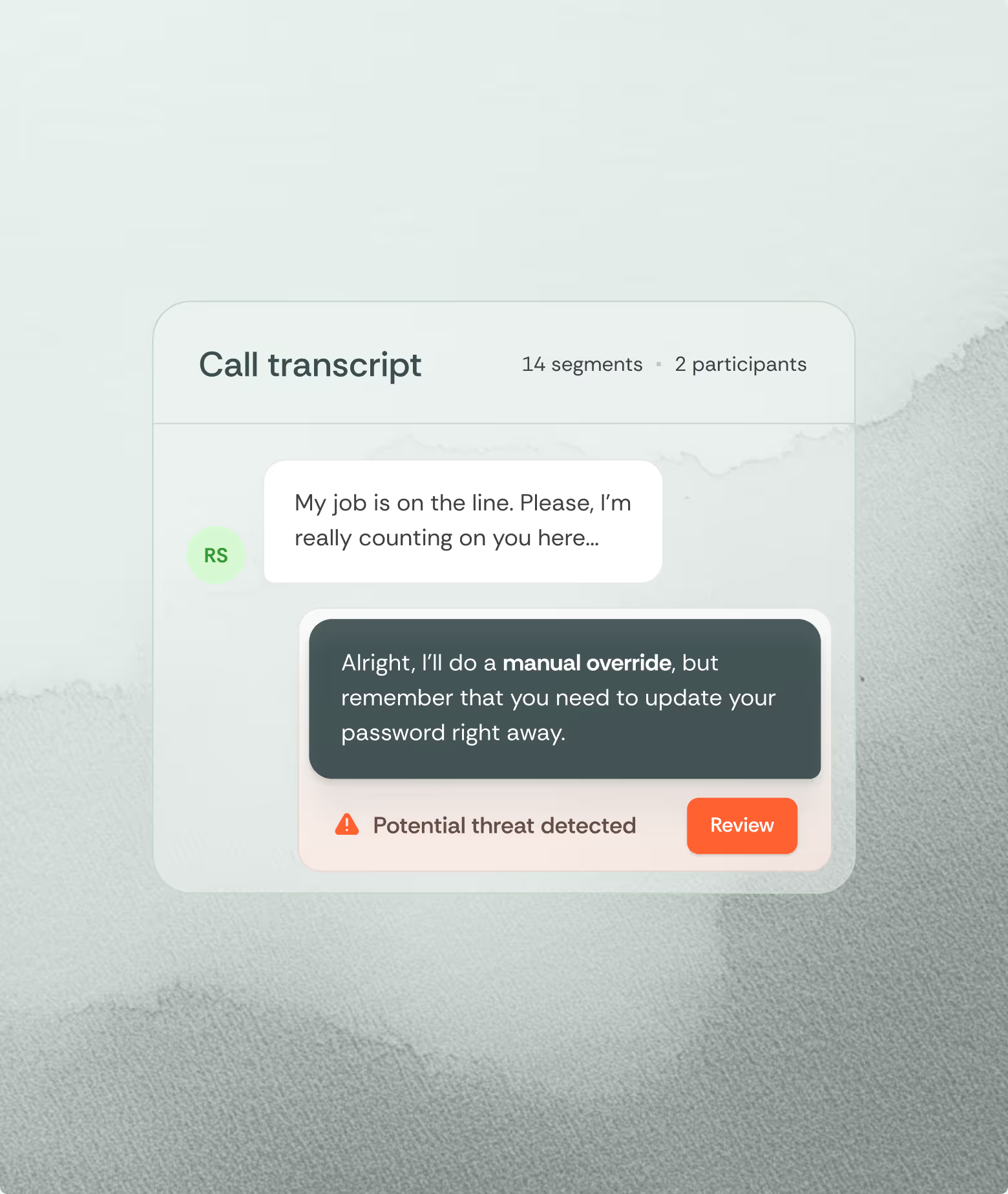
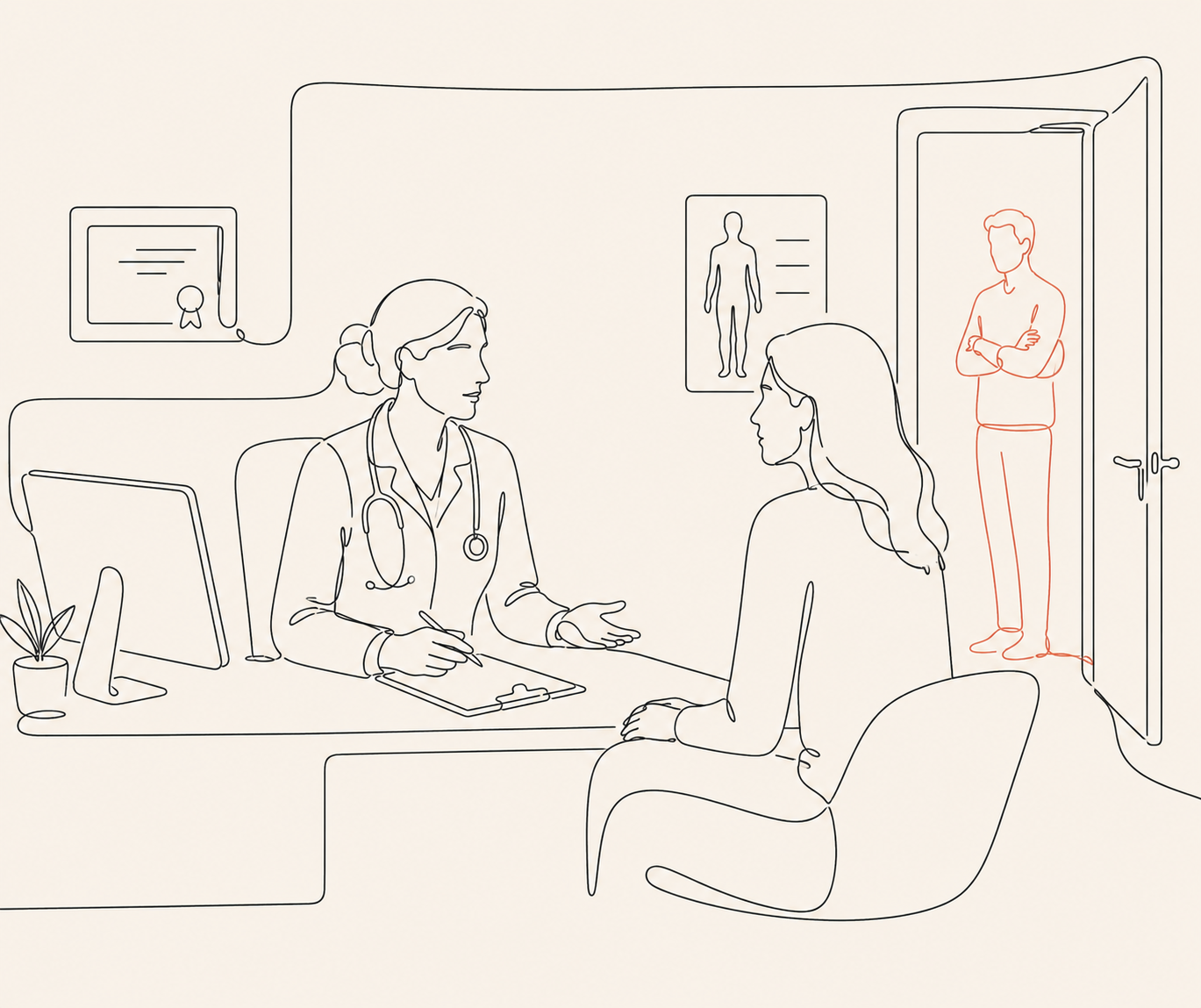
Healthcare professionals are selected for prosocial behavior; they enter the sector to help people. This creates a cognitive vulnerability: the impulse to resolve a request, to heal, to not obstruct someone who needs assistance. Social engineers frame requests around patient care, urgency, or colleague distress, and the prosocial impulse short-circuits verification.
A plausible professional identity situated within a familiar workflow produces the same procedures employees use for legitimate interactions. They are not failing to think; they are thinking as their environment trained them to. Ambiguity, incomplete answers, and minor inconsistencies are absorbed because constantly challenging them would create friction in workflows where delay can carry real costs.
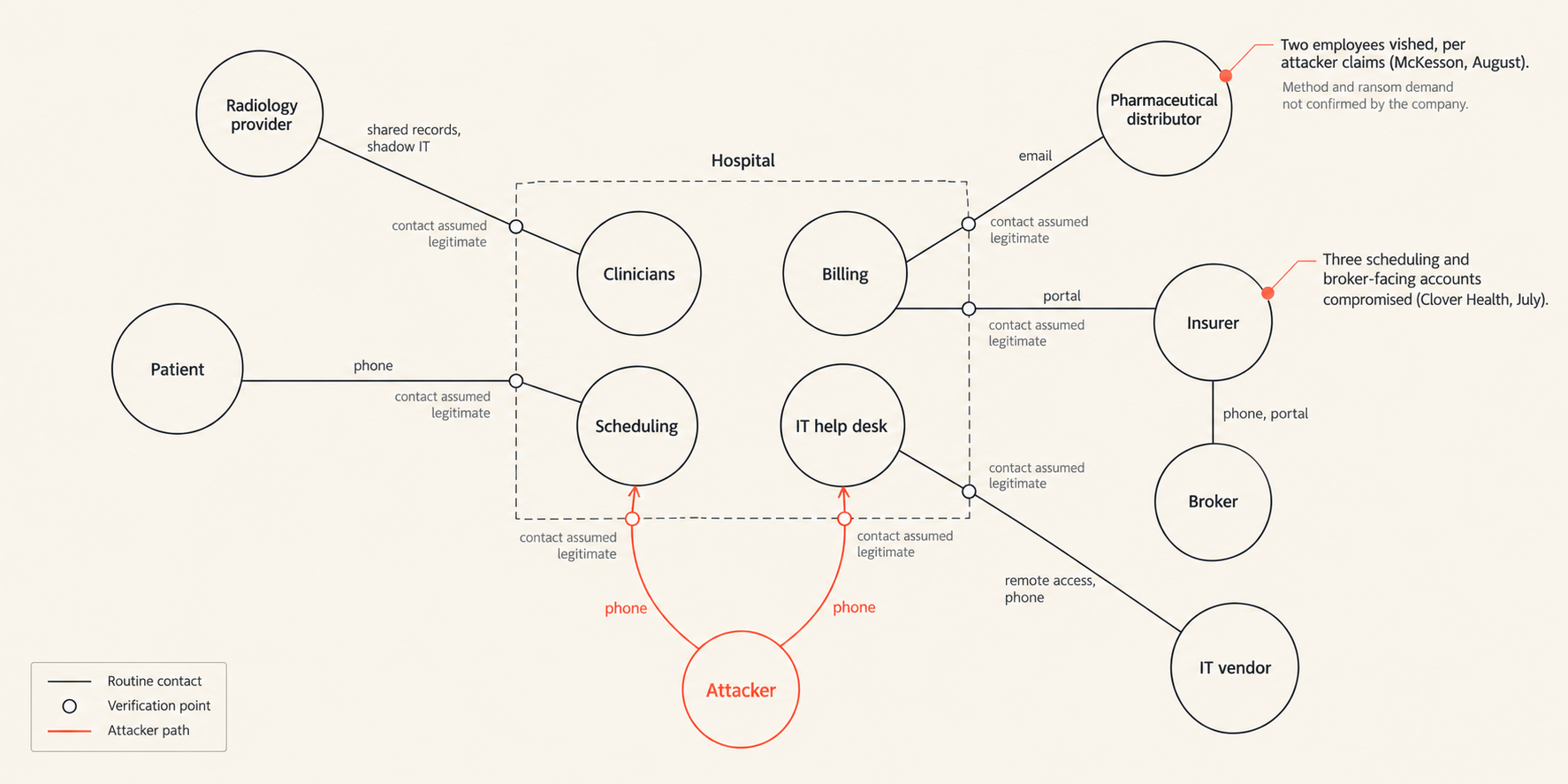
Figure 1. Distributed network of healthcare delivery.
The high-pressure, high-stakes environment compounds this. Clinical staff’s work is defined by cognitive load, time pressure, and competing demands. Adding verification friction to every interaction is not a realistic expectation in this context. As security awareness research has shown, awareness of a threat does not necessarily translate into changed behavior when cognitive bandwidth is already consumed by the primary task.
Also, clinical skill does not transfer to social engineering detection. Healthcare expertise and cybersecurity are separate domains; a nurse who can triage trauma in seconds is unlikely to recognize a pretexting call. Expecting staff to serve as a human detection layer, without dedicated tools or protected time, is a design failure that creates psychological debt training cannot resolve.
Legacy Systems: Social and Technical
Healthcare’s technical legacy problem is well known: old software and difficult-to-patch clinical systems persist because replacing them can disrupt care. The 2021 HIMSS survey found that 73% of healthcare organizations ran legacy operating systems, including Windows Server 2008 and Windows 7. Medical devices with outdated firmware cannot be patched without risking clinical function, keeping the attack window wide. AI-assisted vulnerability discovery is widening it further, a capability not confined to any single lab's models.
We also see legacy practices. Healthcare organizations accumulate workarounds the way they accumulate outdated systems: shared logins, unlocked workstations, password sharing for clinical applications, and informal credential transfers between shifts, all adaptations to environments where security controls conflict with workflow.
Like legacy technology, these practices persist because they solve operational problems. Removing them without workable alternatives creates friction staff will route around. Each gap between policy and practice becomes an opportunity for social engineers.
Table 1. Features of social engineering attacks in healthcare
Why Healthcare Pays: The Dividend Attack
Breaches can be a one-time event. More often the data they provide is like a renewable resource, reducing the friction of pretexts and impersonations.
This is a dividend attack. The initial theft is the principal. Financial fraud against the breached institution, identity theft against the individuals described in the data, and impersonation of the institution to target those same individuals are separate returns on the same theft. One compromise producing many payouts.
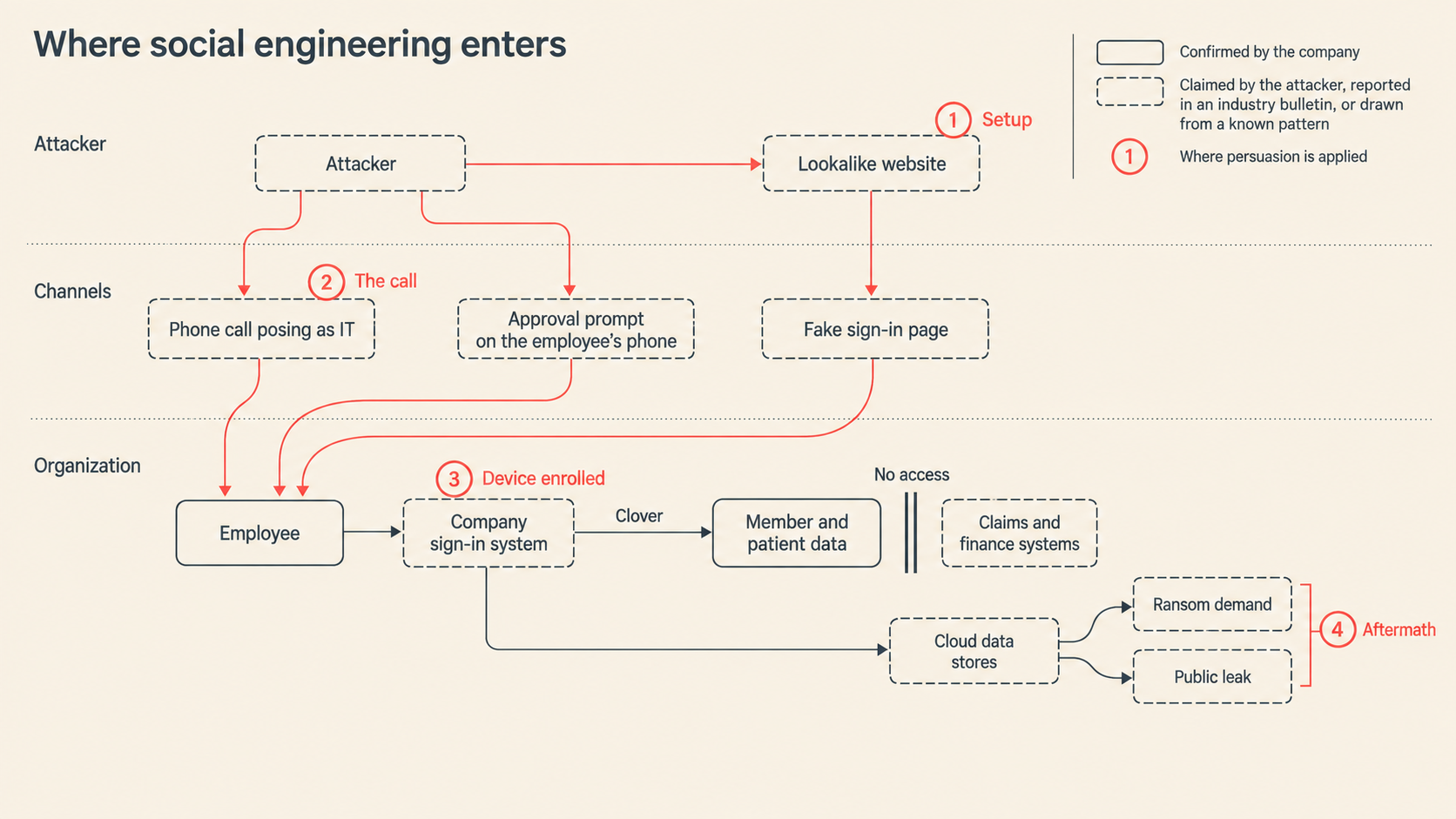
Figure 2. The dividend attack.
These attacks are evergreen. Each dividend can be cashed whenever it becomes advantageous, on a schedule unconnected to when the others are cashed, or whether they are cashed at all. Clover Health’s July 2026 incident shows the pattern without the payout. Three compromised employee accounts exposed PII and PHI but not financial or claims systems. Containment stopped the intrusion but it cannot prevent future misuse of the stolen data.
McKesson's August breach shows the payout side of the same pattern. ShinyHunters vished two employees, pivoted into its Salesforce and Snowflake environments, took roughly a terabyte of data, then collected two dividends off that theft: a $55 million extortion demand, and a public leak of patient and employee data once the demand went unmet. One breach, collected twice, on two clocks.
Medical records and account numbers provide attackers with distinct capital. A credit card enables one class of fraud against one account, largely exhausted once the card is cancelled. The theft of a medical record has multiple effects that produce value for adversaries including resale, identity theft, secondary extortion, and impersonation. Each dividend can be collected independently whenever it is convenient.
How to Prescribe Patches for Healthcare Organizations
These attacks require system-level controls at the points where people, procedures, and technology interact.
Organizations must understand that patient safety extends beyond the clinic and healthcare facilities to data centers and networks that contain sensitive information. A stolen record can harm a patient long after the breach is contained. Much like a patient’s health, the health of the procedures must be assessed continuously.
Healthcare already has the tools to act on this. Patient safety programs encourage staff to report near misses without blame, review them, and redesign the systems that produced them. Security practices should follow the same logic. A suspicious call requires the same reporting, review, and redesign.
What is feature engineering
In practice, feature engineering is both science and a bit of witchcraft. It often involves both iteration and experimentation to uncover hidden patterns and relationships within the data. For instance, a data scientist might transform raw sales data into features such as average purchase value, purchase frequency, or customer lifetime value, which can significantly boost the performance of a churn prediction model. By thoughtfully engineering features, practitioners can provide machine learning models with the most informative inputs, ultimately leading to better accuracy and more robust predictions.
What’s more?
- Incorporate more and more data sources
- Feature engineering platform
What is data engineering
As we mentioned above, feature engineering is certainly a subset of data engineering. It involves the ingestion of data from a source, applying a series of transformations, and making the final result available to be queried by a model for training purposes. You can construct feature engineering pipelines to resemble data engineering pipelines, having schedules, specific source and sink destinations, and availability for querying. However, this configuration would only really apply once you have surpassed the experimentation stage and determined a need for a consistent flow of new feature data.
What is feature engineering
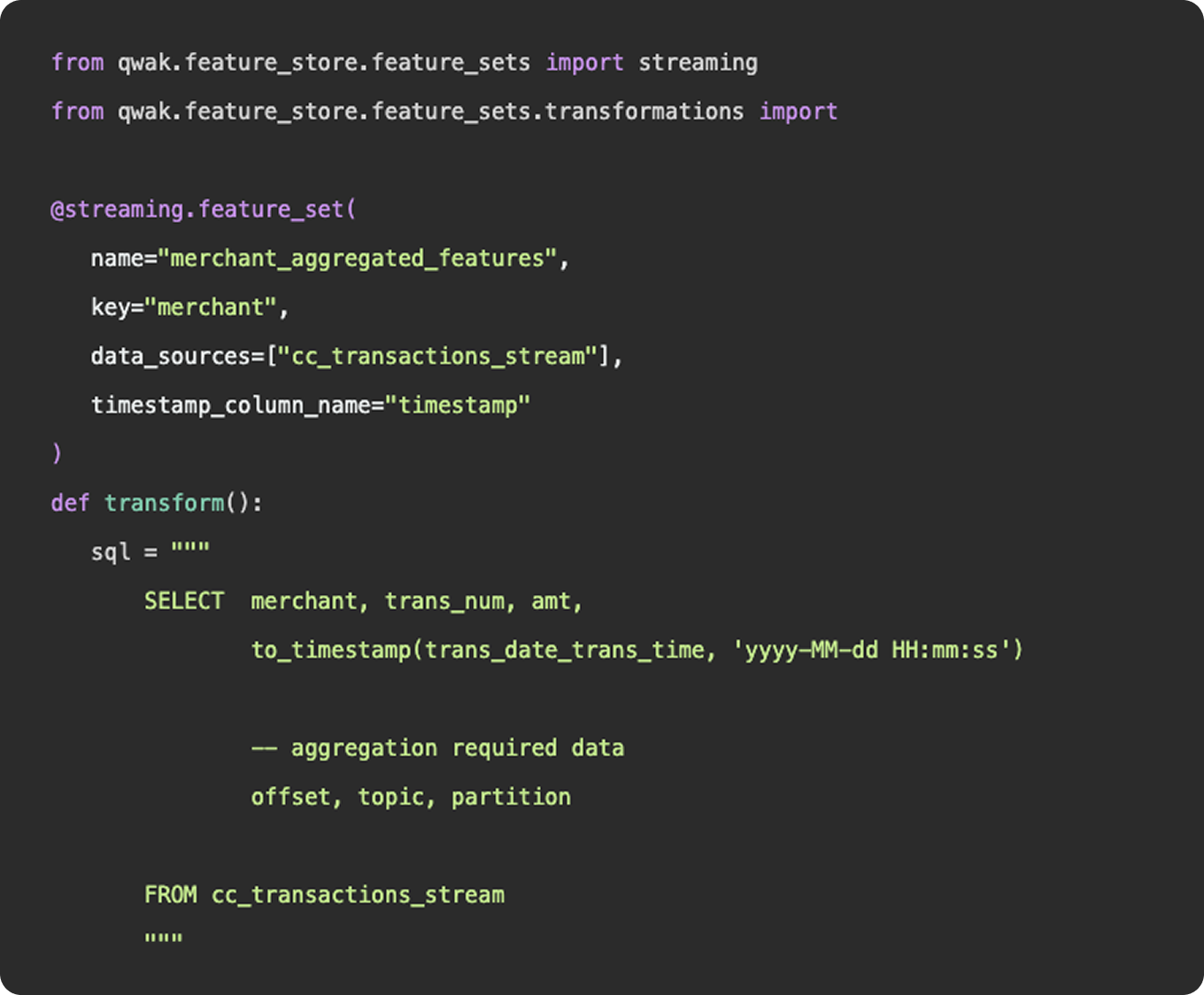
1. Functions
Functionally, there is nothing to differentiate data vs features - data points (link). Where feature engineering and data engineering really differ is in the objectives and motivations for constructing the pipelines. In general, data engineering serves a broader, more unified purpose than feature engineering. Data engineering platforms are constructed to be flexible and universal, ingesting various types and sources of data into a unified storage location where any number of transformations and use cases can be applied. The intent of a well constructed fact table or gold layer in a data lake is to provide a single source of truth that answers many different questions, produces many reports, and can be consumed by many downstream customers.
2. Practise
And in practice, an organization’s data engineering team will be responsible for the curation and maintenance of all data pipelines, not just those that relate to machine learning. These pipelines may power BI dashboards used by C-Suite, auditing reports that feed payroll, or event logs that show a user’s history of actions within the application.
Feature engineering, on the other hand, serves a specific purpose, finding the tailored inputs and columns that will generate the best predictive results for a machine learning model. Data scientists and machine learning engineers are not tasked with developing a universal data model that will ingest all data points throughout an organization, they just need to select, curate, and clean the data needed to power their models.
3. Machine learning
Now, as machine learning teams grow and begin to incorporate more and more data sources into their models, their feature engineering platform may start to resemble a larger data engineering platform in the tools and methodologies they employ. But, the intent is not to establish flexible data models that can be used throughout the organization - it is simply to power their machine learning models.