Social Engineering has a Grammar: You Have to Learn to Read It


Social engineering attacks aren't collections of tricks. The ‘art’ of social engineering requires understanding and responding to a target. Like sentences, attacks have a grammar: they are more constrained. If you understand the grammar, you can defend against social engineering.
The success of vishing calls and phishing emails does not occur in a vacuum, it exploits basic features of human psychology. Reading security blogs, you’ll often find generally reference to urgency, authority, and rapport-building. These are Cialdini’s greatest hits, but their discussion is usually oversimplified. No single cue unlocks compliance.
‘Pretexts’ are the black boxes of cybersecurity. We can only see what goes inside them (words and intonation) and what comes out (compliance). Tactics, techniques, and procedures (TTPs) suggest that there’s far more to them, but these taxonomies are inert lists rather than living attacks. We have to address the gap between the ‘art’ and ‘science’ of social engineering.
That's why it makes sense to look for something like a grammar of social engineering. Not single cues that unlock compliance, but sets of rules that are both structured and flexible.
How Grammar and Cues Constrains Meaning
A sentence isn't a bag of words. Word order makes a difference. "Hacker attacks analyst” and "analyst attacks hacker" contain the same lexicon but have an opposite meaning. Words do carry a unique meaning, but the order is critical.

Figure 1. Attacker’s attempt to use cues to appear to following a formal, normalized business process. Defenders must be aware of the appropriate procedures to defend against it.
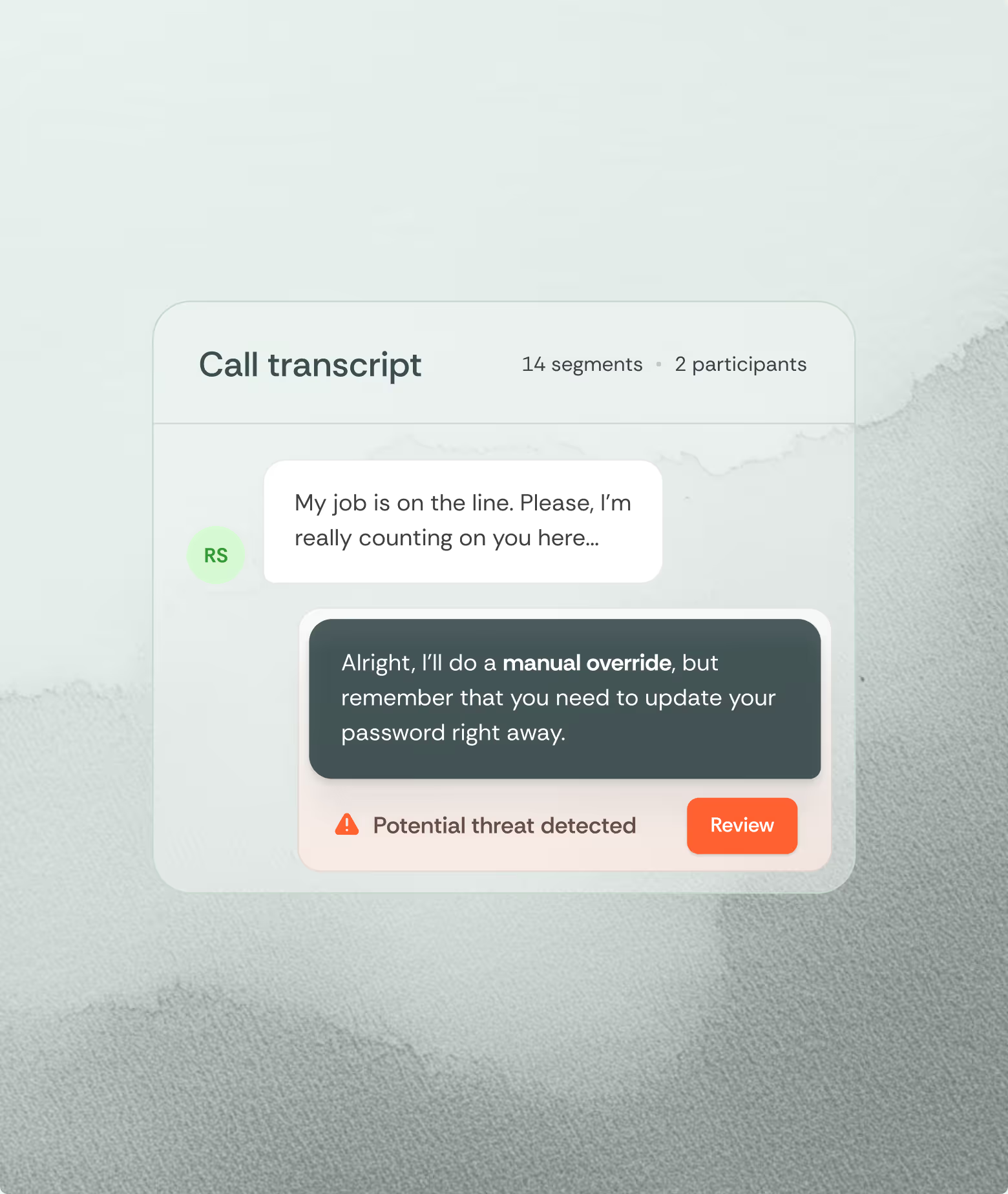
Social engineering should work the same way. Social cues are spread throughout our sentences. “I’m from the Bank of X, we have noticed suspicious activity on your account” establishes authority within seconds. When legitimate, this statement establishes a person’s status and their motivations - and the expectations of the call recipient. None of these pieces is dangerous alone, they need to work together. When distributed properly, "I'm calling from IT" justifies the request "can you read me the code on your screen".
It’s a mistake to assume that our intuitions are always - or mostly - right. Deception cues are hard to find, but people are sensitive to them. If you put the right social cues in the wrong order it can alert someone’s mental SOC. The call recipient can have an uncanny experience. But this feeling can be triggered by an inconsistency, not necessarily the correct ones.
Training is based around this idea: If we present the right cues and examples, then they can detect them. The problem is that training focuses on only a few cues, often ignoring the larger pattern. In the same way that we cannot learn French, Spanish, or Korean from a single class, we can’t expect a training session to build human lie detectors.
Figure 2. Conversational exchanges can continue indefinitely. They require that the two parties take the others perspective, requesting and providing information.
Structuring the Social. Humans are cognitive misers. If we can reduce our mental workload, we will. To make our lives easier, we create schemas in memory for common kinds of people and situations. CEOs have authority. Deals are scarce and time-dependent. We also make rules to complement these: if I’m speaking to a CEO, then I will comply; if a deadline is impending, I need to act on it.
This means that social engineering would be defined by a small, closed sets of social cues, schemas, and scripts the same way language works. These [representations] are the building blocks of a pretext. People establish their identity, make a request, and expect an answer. Throughout, they try to build rapport to create a sense of security and familiarity. When the time is right, urgency can be introduced and escalate the request slowly until the target complies or they exit. Even if they don’t hang up, this passive compliance allows attackers to play the long game.
Each of these steps in a conversation looks normal. If we try to focus on deception and persuasion cues on their own, we waste our time: forced laughter, friendliness, a complement are all part of professional environments. Supervisors try to persuade you to work on the weekend, sales people that the shirt looks good on you, or your co-worker to provide them with help.
Why the Ordering is a Social Engineering Signal
Persuasion literature has emphasized that order matters. It works because of basic memory principles: what comes first anchors interpretation of what follows, and what comes most recently is easiest to recall. That’s where cues, schemas, and scripts are stored. We should see that ordering influences social engineering.
In persuasion, the foot-in-the-door effect uses this sequential approach. Instead of making the big ask first, the social engineer starts small. It creates subtle mental inertia, creating drift toward the main target. Each small response and concession keeps the person engaged. It works in the lab and in the wild. Reversing the order and compliance collapses.
When I analyzed over 600 vishing call transcripts, I searched for sequences. Fixed scripts would be too obvious, a would-be victims would hear the mechanical, depersonalized speech and hang-up. This is the same reason why early robocalls failed. But savvy social engineers will adapt with persuasion principles. But framing and conversational logic requires something akin to a grammar of social engineering. Adversaries don’t need to understand this explicitly, intuition can still succeed.

Figure 3. Secure procedures require establishing the identity of a caller before completing a requested action. Attackers can use social cues at key decision points to bypass verification.
Social engineers must make a request. Victims must respond. They can comply by providing information or performing a task or can stay on the line while the social engineer makes their case. They can also refuse or exit. But situations remain ambiguous. Even if the caller is questionable, people tend to avoid confrontation. Most resistance relies on going silent and disengaging. Confrontation is rare. Trail-and-error can help adversaries learn what works and what doesn’t. This only costs them time.
This is also why scripted, unsophisticated pretexting can still succeed against targets. A customer, help desk agent, or CISO can know every tactic in the social engineering playbook and still comply because they arrived in the sequence a normal business call is supposed to arrive in. Combine this with personal and professional stressors and half the stage is set for any would-be social engineer.
How The Trick Works: Script Substitution
Everyone knows about the bait and switch technique: [a person offers something, and then provides something else]. This is hardly a case of mental magic. It only requires that people have short attention and memory spans. If the two offers look similar enough, they switch might go unnoticed.
To reduce their mental workloads, people rely on heuristics that “substitute an easy problem, for a hard problem”. This is how certain tactics in social engineering work a process I refer to as script substitution: an attacker replaces a security script, with a social script. From service workers, their role is to help. For customers, they want help. In both cases, the quickest solution is to rely on a familiar script and let an authority guide us through the process.
When we read vishing scripts, we see that attackers adopt an identity congruent with what they want: legal, banking, customer service, and technical support. When this occurs first, the request that follows comes naturally. If they are a legal authority, they will ask questions consistent with that role. If suspicions do not make them stop and think, the caller is primed to think about the expected next steps. As time passes, the associated ideas - authority, urgency, etc. - come to the surface. Even if a caller starts to question the interaction, most of what they find in their recent memories are consistent: they might not know what is required, they might not remember what was said early in the conversations.
But conversations are exchanges. Both speakers try to understand the other, and provide relevant information. As long as the attacker can keep the caller on the phone, this passive compliance helps them build a case. If the attacker fails to execute a pretext convincingly, there might still be time to recover as long as they can keep the caller focused on their script. If customers don’t know what’s expected of them, an attacker can use a familiar script in place of an organizational procedure.
Why We Must Building for Grammar, Not Just Content
If language and social engineering are based on a small set of units, decreasing our certainty by constraining order, then deliberation will bypass these steps. Attackers have been exploiting that second fact for as long as they've been talking to people. Defenders have mostly been building tools that look at the units. It might be time to build ones that look at the sentence.
Turning the method into detection logic is not easy. Nor do all the lessons transfer. Like insider threat research, organization-based cases are hard to come by. Most believe that reputations will be adversely affected by disclosing breaches, let alone provided exact details of an attack. What data is available is not always structured effectively. Without appropriate taxonomies, we cannot obtain the needed telemetry.
This requires something far more complex than vishing training and more sophisticated than keyword analysis. Consider a few approaches:
Log the Steps, Not Just the Words. How the social cues are used is as important as what they are. Whatever transcript analysis or conversational AI a security team uses, they should examine call structure: which cues were present, in what position, and their relative frequency and location to others. A transcript full of the "right" words in the wrong order can provide an early warning. But AI-supplemented attacks are likely to erode this signal’s validity.
Separating Out Language Conventions from Social Engineering. Language and communications conventions have their own structure. When analyzing transcripts, be aware of word order. Languages like English follow a Subject-Verbal-Object structure and are relatively context-independent. Languages like Korean follow a Subject-Object-Verb structure where speakers must attend to context. Korean also uses honorifics that imply status differences based on age and seniority.
Establish the Ordinary Grammar of Each Channel. Help desk calls, vendor payments, and recruitment are defined by their own sequences. Emails can be fragmentary and occur in multiple, parallel threads. Calls are more linear and contain emotional cues absent from emails. Organizational procedures and policies can - and should - dictate what occurs in each channel. Business such as banking provide emails to customers about these procedures, but they can easily be intercepted and integrated into pretexts.
What is feature engineering
In practice, feature engineering is both science and a bit of witchcraft. It often involves both iteration and experimentation to uncover hidden patterns and relationships within the data. For instance, a data scientist might transform raw sales data into features such as average purchase value, purchase frequency, or customer lifetime value, which can significantly boost the performance of a churn prediction model. By thoughtfully engineering features, practitioners can provide machine learning models with the most informative inputs, ultimately leading to better accuracy and more robust predictions.
What’s more?
- Incorporate more and more data sources
- Feature engineering platform
What is data engineering
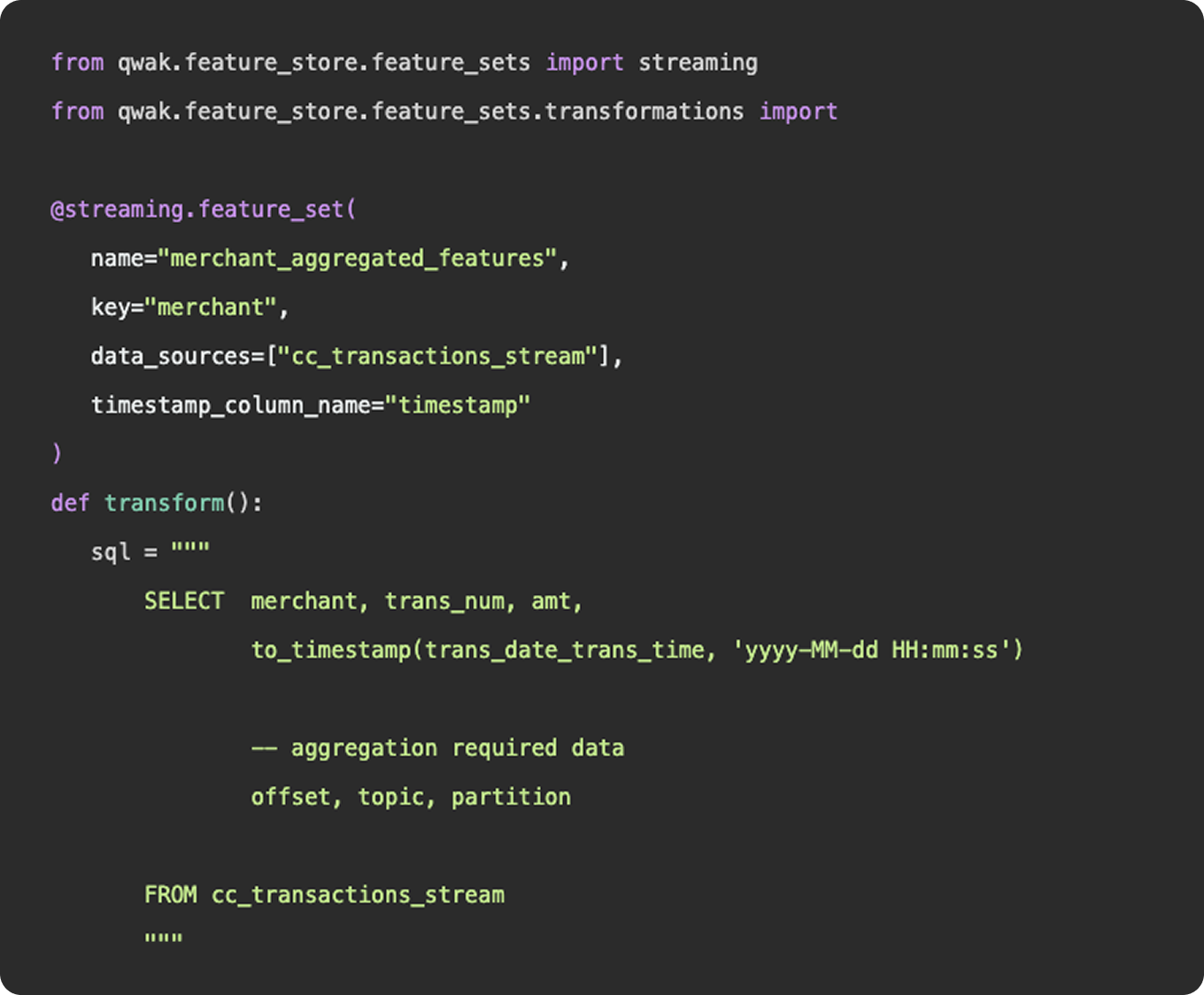
As we mentioned above, feature engineering is certainly a subset of data engineering. It involves the ingestion of data from a source, applying a series of transformations, and making the final result available to be queried by a model for training purposes. You can construct feature engineering pipelines to resemble data engineering pipelines, having schedules, specific source and sink destinations, and availability for querying. However, this configuration would only really apply once you have surpassed the experimentation stage and determined a need for a consistent flow of new feature data.
What is feature engineering
1. Functions
Functionally, there is nothing to differentiate data vs features - data points (link). Where feature engineering and data engineering really differ is in the objectives and motivations for constructing the pipelines. In general, data engineering serves a broader, more unified purpose than feature engineering. Data engineering platforms are constructed to be flexible and universal, ingesting various types and sources of data into a unified storage location where any number of transformations and use cases can be applied. The intent of a well constructed fact table or gold layer in a data lake is to provide a single source of truth that answers many different questions, produces many reports, and can be consumed by many downstream customers.
2. Practise
And in practice, an organization’s data engineering team will be responsible for the curation and maintenance of all data pipelines, not just those that relate to machine learning. These pipelines may power BI dashboards used by C-Suite, auditing reports that feed payroll, or event logs that show a user’s history of actions within the application.
Feature engineering, on the other hand, serves a specific purpose, finding the tailored inputs and columns that will generate the best predictive results for a machine learning model. Data scientists and machine learning engineers are not tasked with developing a universal data model that will ingest all data points throughout an organization, they just need to select, curate, and clean the data needed to power their models.
3. Machine learning
Now, as machine learning teams grow and begin to incorporate more and more data sources into their models, their feature engineering platform may start to resemble a larger data engineering platform in the tools and methodologies they employ. But, the intent is not to establish flexible data models that can be used throughout the organization - it is simply to power their machine learning models.