Targets Without Training: What We Can Learn From Bank Fraud Warnings


Security teams often describe defense as a wall. Employees are the bricks. The processes are the mortar. Cracks can be patched, but without structural repair, walls will crumble. This internal focus can often ignore vendors, contractors, and customers. While vendors and third parties can have their own training, customers definitionally do not.
Without training, fraud warnings and educational pages are the main material banks use on that section of the wall. Education pages can provide general information, but they are often outdated. This information is published after an attack. Banks hope that the information can provide a mental patch to stop the same attack from succeeding again. A patch does not fix the wall.
Bank fraud warnings are not CVEs. A CVE record identifies one flaw in one product. Security teams track it until a fix is applied. Fraud warnings are meant to be persuasive. They describe legitimate (“We may call you to confirm a payment”) and illegitimate behaviors (“We will never ask for your one-time passcode”). These dos and don’ts can become blurred in customers’ memory. Warnings also contain information about the decision points an attack depends on. Across time and banks, these decision points define recurrent attack patterns and identify ongoing campaigns.
My preliminary analysis assessed 500 public bank fraud warnings from 26 banks in Australia, Canada, Singapore, the United States, and other countries. I used the attack pattern framework developed by Humanix to examine the features of the attack patterns described in these warnings. Each warning was assessed against the seven dimensions in Table 1, below.
How fraud warnings are assessed
Banks publish fraud warnings more frequently than education pages. The patches might be faster, but they do not address the underlying problem: successful social engineering attacks are subtle, and the warnings are too general to stop sophisticated attacks.
Australia’s financial regulator and the UK’s Financial Ombudsman Service have found that few banks test whether their warnings work. A Danish study tested one bank’s warning against real fraud records. The researchers found no measurable effect on fraud.
Other studies suggest that warnings are most effective when they are specific, timed at the moment of risk, and give the person a clear way to stop. Their effects decline with repetition and over time. Laboratory studies overestimate these effects. Participants know to expect fraud. The alertness of a test differs from the fear and time pressure of a real attack.
The persuasiveness of a message depends on the content (quality and quantity), the audience, and the context. If messages are not being analyzed and assessed against these standards, we leave success to chance.
How warnings work as persuasive communication
Bank communications are persuasive messages. They promote new accounts, credit cards, and mobile apps. They are written to change what customers believe and do. Fraud warnings are also persuasive messages. They are written to promote good security practices and to discourage bad ones.
Figure 1. Simple model of persuasion. Motivation and ability determine whether readers rely on their intuitions and familiarity or deliberate by evaluating and integrating information.
Warnings have limits associated with the audience (person), the complexity of the subject (task), and changes in technology and attacks (environment):
- Customers may not read the warning. Those who do might think they can catch a scam.
- The advice can be too general to apply to a specific attack.
- Warnings are published after an attack on the bank’s customers or on another institution’s.
- Attacks change over time. Warnings describe past attacks.
- Warnings can list actions to avoid without describing what to do instead.
In my first analysis, I examined what kinds of information these warnings contain. Humanix has proposed a human-centric threat intelligence schema that identifies seven dimensions. I assume that these dimensions can describe any interactive social engineering attack. Table 1 shows which elements of each dimension can be recovered from the warnings.
In a regional, homogeneous example, coverage differs by dimension (Table 1). Most warnings describe the kinds of requests and corresponding justification, the channels that can be compromised, and the kinds of identities used. Only 10% of attack paths link the request to the resource the attacker targets.
Table 1. Share of CBA and NAB warnings (%) that address each dimension.
Warnings often do not address the dynamics of interaction and organizational structure and controls. Many of these choices make sense. Discussing organizational structures and controls and what an attack enables can provide public information that is useful to attackers (OSINT). Security teams face the same trade-off when they publish service desk procedures.
Describing the interaction dynamics might help customers. It is difficult to do. Attacks are complex and rely on social and linguistic cues that are expressed and detected rapidly. This is the kind of material that is loosely addressed in security awareness training for employees but rarely provided to customers.
Attack patterns defined in warnings
Warnings were coded for the steps of the attack. Each pattern is a chain from an entry pretext to an endpoint.
I identified 25 attack patterns in nine families (Figure 2). Credential capture and data harvest are the most common. Together they appear in 69 attack paths. Eight patterns appear in three paths or fewer.
Figure 2. Attack-pattern catalogue by family. Bars show the number of attack paths that describe each pattern.
One basic pattern is the most common. An attacker impersonates a bank, agency, or courier. The attacker raises a problem with the customer’s account and asks for specific information such as a code, password, or card detail. It appears in 40 attack paths.
Many of the warnings contain basic information. Most pattern definitions link two steps. Most attack paths are longer. Of 282 paths with an explicit order, 68% run three or more steps. A minority of warnings describe chains of four to six steps. Table 2 lists five of these sequential attacks.
Table 2. Selected sequential attack patterns.*
*Notes: (1) Bank of Ireland (Ireland): 4 stages. (2) DBS (Singapore): 6 stages. (3) Capital One (United States): 5 stages. (4) RBC (Canada): 4 stages. (5) DBS (Singapore): 5 stages. Pattern IDs follow the catalogue in Figure 3. * Step that relies on a social cue (rapport, reciprocity).
The warnings list the technical steps. They include little about how an attacker might promote compliance for a request at each step of the process. I have called the attacker’s method script substitution: there are sufficient social and linguistic cues to make the situation appear similar to a legitimate process. This depends on the attacker’s ability to present and withhold social cues and on the defender’s expectations.
Warnings describe requests in detail and aftermath in little. Post-compromise activity appears in 4% of records from the other banks. Implemented remediation appears in 2%.
Warnings also rarely include how many contacts an attack takes or how long it lasts. A security operations team needs these details to detect a multi-stage attack in progress.
The knowledge provided and how customers can(not) use it
Customers have better things to do with their day than stay on guard. Comprehensive defense requires time, mental resources, and knowledge they do not have.
Warnings require customers to perform three kinds of tasks:
- Recognition: assessment of deception and legitimacy.
- Compliance: following specific rule(s).
- Out-of-channel verification: contacting the bank through a known number or app.
Each of these tasks has a different source of error. Recognition relies on intuition. Compliance requires making sense of when a rule should be applied. Verification requires specific steps.
Warning design must account for mental load. In Table 2, describing long pretexts requires that customers remember each step and its sequence. Studies of memory demonstrate that item and order information are dissociable. A customer can remember each step and still forget the order.
What financial institutions should do now
In some cases, warnings describe attacks with a reasonable degree of nuance and contain useful information. They also place the burden of protection on customers and can overestimate customers’ ability to defend themselves.
Taken together, bank warnings are a source of threat intelligence. They record the decision points of attacks against customers. Security teams can catalogue these patterns and track them by campaign, channel, and date.
Customers read warnings when they are calm and must apply them under pressure. Customers need advice they can apply when they need it. We must assume the worst case: a familiar, authoritative persona and a consequential loss that needs action now. Adopting secure channels and building in nudges and friction at high-risk payments reduces what customers must remember.
Attacks and fallbacks. Customers cannot be left to defend themselves. They might be bricks, but they are not the mortar. Organizations need to map how customers interact in channels that allow access to accounts and payments. Limiting the action with design reduces vulnerabilities and can expedite recovery.
Test your defenses. A defensive wall needs to be tested. No matter how accurate the rules, customers’ interpretation and self-efficacy can undermine any defense. Financial institutions must sample customers’ competence to determine what they understand and how confident they are.
Document and standardize attacks. Organizations must work together on standards for shareable, actionable human threat intelligence. Each step of an attack pattern records what the target was led to do. These actions can be catalogued as interaction vulnerabilities and exposures (IVEs) and reported in the same terms as software risk.
What is feature engineering
In practice, feature engineering is both science and a bit of witchcraft. It often involves both iteration and experimentation to uncover hidden patterns and relationships within the data. For instance, a data scientist might transform raw sales data into features such as average purchase value, purchase frequency, or customer lifetime value, which can significantly boost the performance of a churn prediction model. By thoughtfully engineering features, practitioners can provide machine learning models with the most informative inputs, ultimately leading to better accuracy and more robust predictions.
What’s more?
- Incorporate more and more data sources
- Feature engineering platform
What is data engineering
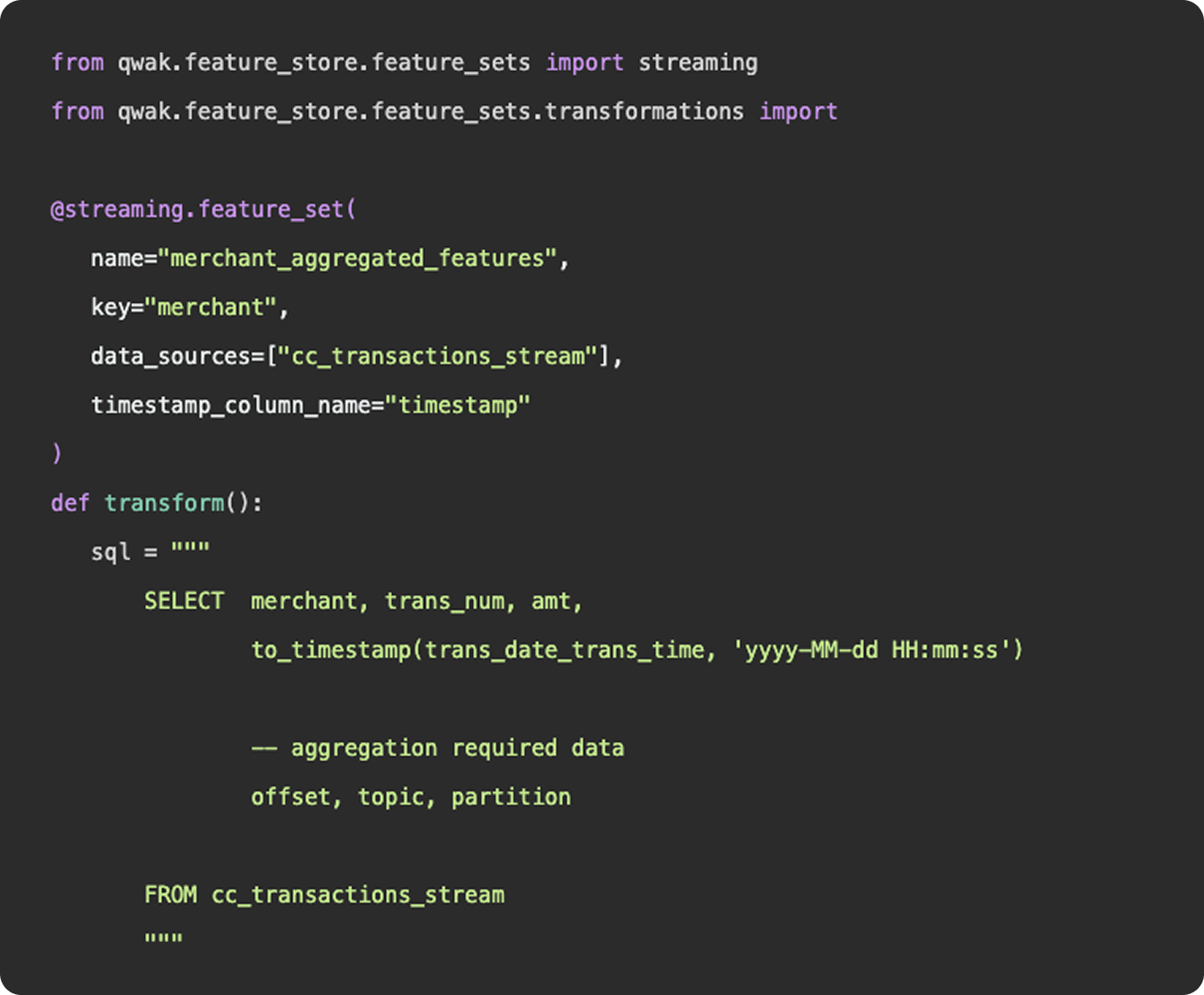
As we mentioned above, feature engineering is certainly a subset of data engineering. It involves the ingestion of data from a source, applying a series of transformations, and making the final result available to be queried by a model for training purposes. You can construct feature engineering pipelines to resemble data engineering pipelines, having schedules, specific source and sink destinations, and availability for querying. However, this configuration would only really apply once you have surpassed the experimentation stage and determined a need for a consistent flow of new feature data.
What is feature engineering
1. Functions
Functionally, there is nothing to differentiate data vs features - data points (link). Where feature engineering and data engineering really differ is in the objectives and motivations for constructing the pipelines. In general, data engineering serves a broader, more unified purpose than feature engineering. Data engineering platforms are constructed to be flexible and universal, ingesting various types and sources of data into a unified storage location where any number of transformations and use cases can be applied. The intent of a well constructed fact table or gold layer in a data lake is to provide a single source of truth that answers many different questions, produces many reports, and can be consumed by many downstream customers.
2. Practise
And in practice, an organization’s data engineering team will be responsible for the curation and maintenance of all data pipelines, not just those that relate to machine learning. These pipelines may power BI dashboards used by C-Suite, auditing reports that feed payroll, or event logs that show a user’s history of actions within the application.
Feature engineering, on the other hand, serves a specific purpose, finding the tailored inputs and columns that will generate the best predictive results for a machine learning model. Data scientists and machine learning engineers are not tasked with developing a universal data model that will ingest all data points throughout an organization, they just need to select, curate, and clean the data needed to power their models.
3. Machine learning
Now, as machine learning teams grow and begin to incorporate more and more data sources into their models, their feature engineering platform may start to resemble a larger data engineering platform in the tools and methodologies they employ. But, the intent is not to establish flexible data models that can be used throughout the organization - it is simply to power their machine learning models.